Introduction
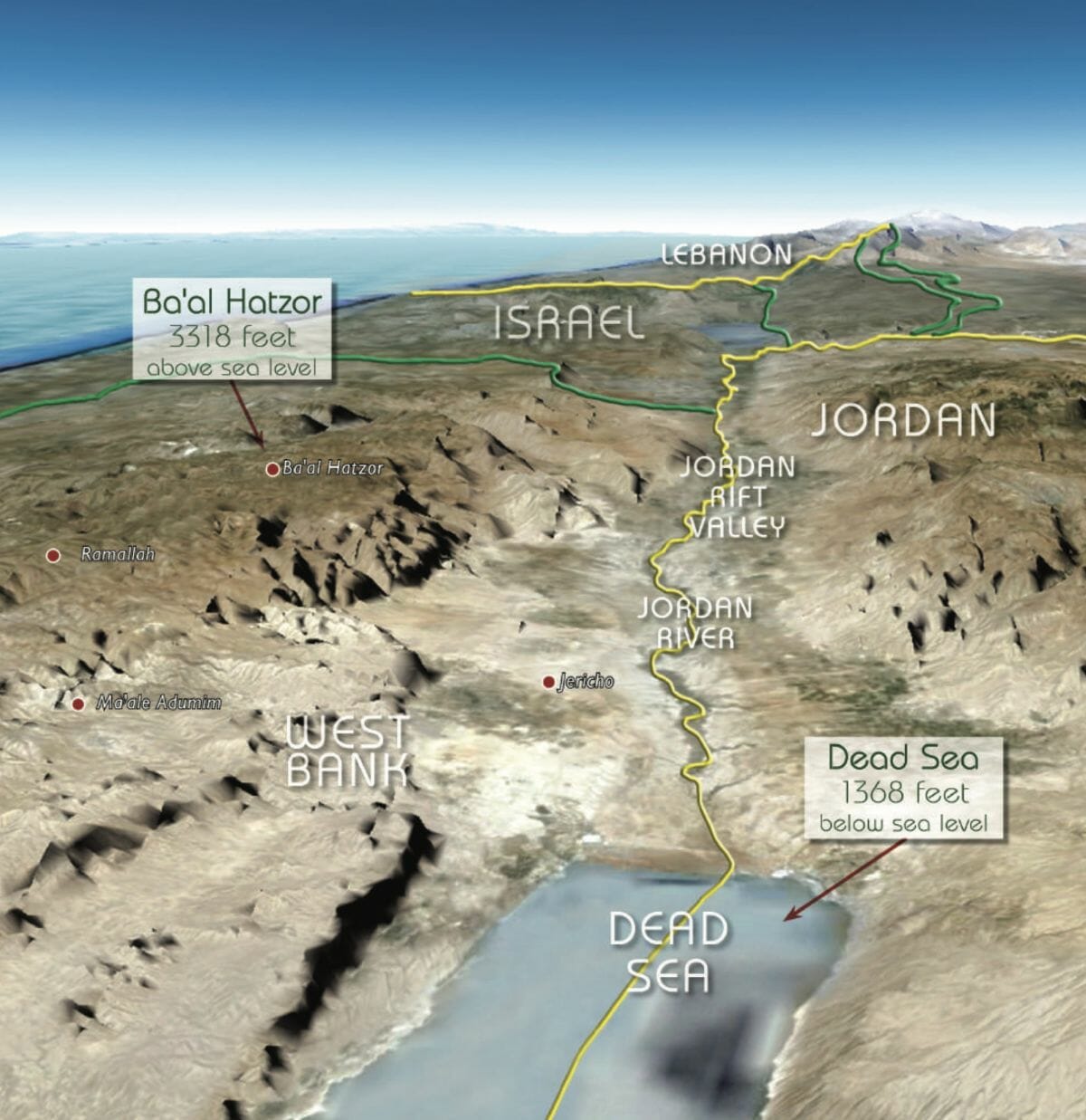
The concept of “strategic depth” occupied a central place in Israeli military thinking for decades. It was based on the vulnerability of the narrow coastal plain, the dominance of the heights of Samaria and Judea, the risk of a rapid breakthrough to the sea, and the impossibility of building a multi-layered defense without territorial control.
However, this concept was formulated in the era of tank armies, massed artillery, and limited means of observation. In the conditions of modern warfare – with drones, precision weapons, and persistent intelligence – its key assumptions require rethinking. Below is a detailed analysis of each thesis of strategic depth and the extent to which it corresponds to the realities of the 21st century.
Lack of Strategic Depth (the narrow “waist” of 12–15 km)

Then:
According to the classic scenario described in the late 1960s, the tank armies of Iraq, Syria, and Jordan would break through from the east, reach the sea in the Netanya – Tel Aviv corridor, split the country in two, and cut the north off from the south.
Today:
- Iraq no longer has those tank armies, Syria is devastated, and Jordan is a partner in peace and security; a mass armored breakthrough from the east in its classic form is highly unlikely.
- The main threats today are missiles, multiple rocket launch systems (MRLS), UAVs, pinpoint raids, and hybrid formations, rather than corps-level offensives.
- The experience of the war in Ukraine shows that large mechanized columns and “waves of tanks” become easy targets for drones, anti-tank guided missiles (ATGMs), and real-time intelligence. “Depth” measured in kilometers matters less than the depth of the radar, drone, and fire-control field.
What the Metatron perimeter concept offers:
- Physical depth is replaced by temporal and informational depth: the Wall and the Line, with a powerful layer of sensors and AI analytics, provide an early-warning “horizon” tens of kilometers beyond the Line, well before forces approach the Wall.
- Any movement of significant forces toward the Line is detected in advance. This gives the IDF time and space to employ precision strikes, rather than relying solely on ground maneuver.
- The security perimeter inside Israel makes it possible to move the line of contact away from the critically narrow corridor and anchor defense to pre-prepared nodes.
Loss of Dominant Heights in Samaria and Judea

Then:
Whoever controls the mountain ridge controls the coastal plain through artillery, observation, air defense, and radar systems.
Today:
- Heights still provide a significant advantage for observation and for rockets/MRLS; geography has not changed.
- At the same time, intelligence is increasingly less dependent on terrain. It is based on satellites, UAVs, aerostats, and synthetic aperture radar (SAR).
- Strike weapons (missiles, loitering munitions) can be launched from a distance, not necessarily from the ridge itself.
- The experience of Ukraine shows that observation from heights remains important, but networked sensors and the ability to rapidly engage targets are even more critical than simply observing from above.
What the Metatron perimeter concept offers:
- Within Metatron, the heights are treated as critical zones of the red segment of the Wall. They are covered by maximum saturation of sensors, air and missile defense systems, and counter-UAV capabilities.
- The Metatron concept assumes a strict regime of demilitarization and control over any heavy systems on these heights, ensured through a combination of international mechanisms, sensors, and automated monitoring.
Vulnerability of Aviation and Critical Infrastructure

Then:
Airfields, ports, power plants, and communications hubs were within direct line of sight and artillery range from the West Bank.
Today:
- The role of the following has increased significantly:
- short- and medium-range missiles, as well as medium- and shorter-range missiles (INF/RSMR category),
- cruise missiles,
- UAVs and drone swarms.
- As a result, most key facilities are vulnerable not only from the West Bank, but also from Lebanon, Syria, the sea, and even from Iran.
- The experience of Ukraine shows that stationary airbases and power plants without camouflage, decoys, and dispersion become “strike magnets.”
What the Metatron perimeter concept offers:
- It protects against artillery, short-range missile threats, and MRLS fire from the West Bank through:
- continuous surveillance,
- rapid detection of firing positions,
- automated counter-battery warfare.
- At the same time, Metatron by itself does not solve the problem of long-range missiles and drones originating from Lebanon, Iran, or maritime directions.
Limited Freedom of Maneuver for Ground Forces

Then:
Brigades could not properly withdraw, bypass, or conduct flanking maneuvers, as geography “compressed” them.
Today:
- Based on the experience of Ukraine, large-scale mechanized maneuvers are severely constrained:
- drones constantly “hang” over the battlefield,
- columns become visible and vulnerable,
- logistics remain under constant fire.
- Maneuver becomes:
- smaller-scale and more distributed (company/battalion task groups),
- more vertical (helicopters, UAVs),
- far more dependent on concealed routes and underground infrastructure.
What the Metatron perimeter concept offers:
- It creates a predictable frontline along which it is possible to pre-position:
- concentration nodes,
- concealed underground and semi-underground routes,
- pre-prepared “pockets” for counterattacks.
- If the project includes a network of military service tunnels and galleries, maneuver becomes underground and protected from drones.
High Risk of a Rapid Breakthrough

Then:
If defenses were breached at one point, within hours, a junction at the sea would occur, splitting the country.
Today:
- A mass rapid breakthrough by large formations is:
- nearly impossible without total suppression of air defense, drones, and artillery,
- detectable from tens of kilometers away (UAVs, satellites).
- The experience of recent years shows that even limited breaches (such as the attack of October 7) are dangerous, but they do not involve tank armies; rather, they consist of a mix of special forces, terrorist groups, and drone swarms.
What the Metatron perimeter concept offers:
- A Wall with a deep underground component, sensors, and AI makes an undetected breakthrough virtually impossible.
- Any local breach of the Line immediately becomes:
- a tactical incident rather than a strategic breakthrough,
- a target for automated tasking of reserves and fires.
- The Line and its segmentation (green/yellow/red) make it possible in advance to identify areas of higher risk and position rapid reaction forces accordingly.
Vulnerability of Supply Routes and Strategic Highways

Then:
The main highways along the coast could easily be shelled and cut.
Today:
- Logistics is one of the key vulnerabilities, as the war in Ukraine has clearly demonstrated.
- At the same time, new possibilities have emerged:
- decentralized storage,
- underground and protected logistics routes,
- automated, real-time logistics management.
- The threat of shelling highways from the West Bank remains, but it is now supplemented by loitering munitions and FPV drones targeting convoys and hubs.
What the Metatron perimeter concept offers:
- It enables the creation of a protected internal supply corridor, separated by the Wall from direct threats beyond the Line.
- With underground infrastructure, logistics routes can be partially buried and maximally shielded from visual reconnaissance and drones.
Difficulty of Defending Against a Massed Regular Army Attack
Then:
Holding the line required massive troop concentrations, which were costly and inefficient.
Today:
- Large troop concentrations along the front are ideal targets for artillery and drones.
- The experience of Ukraine shows that dispersion combined with mobile groups and long-range fire is more effective than a “thick continuous front.”
- Modern defense is not a chain of soldiers, but a network of sensors, long-range artillery, and drones.
What the Metatron perimeter concept offers:
- The wall and sensor perimeter replace the “continuous front” of manpower.
- Personnel become point-based “reaction nodes” rather than a dense line.
- This dramatically reduces the need to maintain large permanent formations along the Line.
Opponent’s Advantage in Observation

Then:
The heights provided visual control over Tel Aviv, Ben Gurion Airport, and surrounding areas.
Today:
- Ground-based observation is only part of the picture. There are satellites, aerostats, drones, camera networks, and radar systems.
- An opponent still gains an advantage if positioned on the heights with optics, radar, and communications antennas.
What the Metatron perimeter concept offers:
- The project must guarantee that any significant observation or radiotechnical systems on the heights do not go undetected through:
- radio-frequency monitoring,
- electro-optical reconnaissance,
- automated anomaly analysis.
- In addition, a special regime of frequencies and altitudes for emitting systems may be introduced within the Metatron zone.
Increased Vulnerability to Shelling

Then:
Mortars and MRLS from the ridge could cover vast areas.
Today:
- Additional threats include longer-range MRLS, guided missiles, and UAVs.
- The experience of Ukraine shows that the key is not only air defense, but also dispersion, shelters, decoys, and active counter-battery warfare.
What the Metatron perimeter concept offers:
- It provides the fastest possible counter-battery response through sensors and AI (identification of firing source and time).
- Within the demilitarized zone above the tunnel and along the Line, strict limits can be imposed on maximum calibers and system types.
Impossibility of Deeply Echeloned Defense

Then:
Limited territory made it impossible to deploy second and third defensive lines.
Today:
- Echeloning shifts into:
- air (layers of air and missile defense),
- underground (shelters, tunnels, command posts),
- cyber and informational layers.
- Geographic narrowness can be partially compensated by multi-layering across altitude and operational domains.
What the Metatron perimeter concept offers:
- Metatron already serves as the foundation for:
- the first ground echelon (wall + sensors),
- the underground echelon (foundations, tunnels, communications),
- the “digital echelon” (AI, surveillance).
- When integrated with air and missile defense, one or two additional aerial echelons are added.
The Jordan Valley as a Natural Barrier

Then:
It functioned as a “bathtub” in which advancing forces could be delayed and destroyed before ascending to the heights.
Today:
- The likelihood of a tank offensive through the valley is low, but not zero on a 20–30-year horizon (regime collapse in Jordan, Iranian influence, etc.).
- For missiles, drones, and hybrid forces, the valley itself is not a guarantee of security.
What the Metatron perimeter concept offers:
- It can partially replace the role of the valley through:
- a deep engineered line,
- continuous surveillance,
- instantaneous transmission of targeting data.
- However, in the long term, the scenario of the emergence of a hostile regular force to the east must still be kept in mind.
What Metatron Offers Compared to the 1960s Doctrine

- The world of the 1960s (tanks + geographic depth) has been replaced by a world of sensors, drones, missiles, and hybrid threats. Maintaining control over the West Bank for the sake of “geometric depth” is becoming increasingly irrational. The classic argument of “12 km to the sea” no longer captures the main risks.
- Metatron can potentially replace the old doctrine of strategic depth if it is:
- understood as a multi-layered system (underground, ground, air, informational levels),
- formalized as a national system of early warning and control over weapons regimes in neighboring territories.
- Advantages of the Metatron Wall over the Concept of “Strategic Depth”:
- Integration with air and missile defense and counter-UAV systems.
- A special regime for the heights of Samaria and Judea: the principle that “heights are compensated not by holding territory, but by controlling the regime on that territory.”
- A dedicated logistics layer (protected roads, underground routes).
- Military underground infrastructure for maneuver and concealed deployment: a network of operational military tunnels parallel to the wall, concealed exits, pockets, and “maneuver pockets” behind the Line.
- A counter-battery layer as an integral part of the Wall’s design.
- Doctrinal articulation of “Strategic Depth 2.0” in terms of reaction time, sensors, and echeloning, rather than territorial width alone.
- Formalization of Metatron’s role as a national early-warning and targeting system, not merely a wall.
Conclusion
The concept of strategic depth played a decisive role in shaping Israeli military doctrine in the second half of the twentieth century. It was a rational response to the threats of its era – mass armored formations, limited intelligence capabilities, and the need to gain space for maneuver and mobilization.
The nature of warfare, however, has fundamentally changed. Contemporary threats are defined less by geography and more by the combination of real-time intelligence, precision weapons, drones, and hybrid modes of conflict. Under these conditions, territorial kilometers no longer translate automatically into security, while control over space is increasingly replaced by control over weapons regimes, surveillance, and reaction time.
The Metatron project is built precisely on this logic. It does not dismiss geography, but redefines strategic depth as a multi-layered system -engineering, informational, underground, aerial, and legal. Instead of relying on a permanent military presence across the territory, it emphasizes early detection, automated response, and strict limitations on military capabilities in critical zones.
In this sense, Metatron is not an alternative to security but an attempt to adapt it to the realities of the twenty-first century. It offers a framework for maintaining deterrence and defense while reducing the strategic, military, and political burden inherent in the traditional territorial model of strategic depth.


 EN
EN  RU
RU